Many hospital IT teams now face a choice between AWS HealthImaging and Medicai when they must replace an aging on-premise archive with a vendor-neutral archive. The decision hinges on storage pricing certainty, DICOM workflow support, and the need to keep images instantly accessible across multiple sites. The next sections give you the concrete numbers and integration details to pick the right option for your system.
By the end of this article you will know how each platform handles petabyte-scale storage and compliance, how their APIs connect with existing PACS and EHRs, and which pricing model fits your volume of studies. The comparison covers security posture, global data residency, and the specific scenarios where one is the clearer fit.
Quick Verdict: AWS HealthImaging vs Medicai for Vendor-Neutral Archives
Medicai's HIPAA- and GDPR-compliant cloud PACS and Vendor Neutral Archive deliver 1M+ studies per year with 50M+ yearly API transactions, while AWS HealthImaging offers pay-as-you-go medical imaging storage and retrieval.
Transaction volumes differ sharply between the two platforms. Medicai processes 1M+ studies per year and handles 50M+ yearly API transactions. AWS HealthImaging uses generic storage tiers without published medical imaging throughput benchmarks.
Compliance status shows clear distinctions. Medicai operates as a HIPAA and GDPR compliant platform with FDA/CEE cleared viewers and follows OWASP security guidelines. AWS HealthImaging provides standard AWS compliance certifications that apply across its cloud services.
Pricing models reflect different approaches. Medicai uses subscription pricing for its cloud PACS and VNA services. AWS HealthImaging follows a pay-as-you-go cost model based on storage consumption and retrieval requests.
Storage capacity statistics highlight Medicai's medical imaging focus. Medicai maintains 1.7M+ studies in storage with 2M+ imaging studies uploaded overall. AWS HealthImaging stores medical images in generic cloud storage tiers without specialized medical imaging metrics.
Best-fit scenarios depend on deployment needs. Medicai serves hospitals and clinics requiring integrated PACS, VNA, and API access with compliance features. AWS HealthImaging suits organizations that prefer general cloud storage with medical imaging capabilities.
At a glance: how Medicai compares to AWS HealthImaging, Medicai for Vendor-Neutral Archives on the features that matter most.
| Feature | Medicai | AWS HealthImaging | Medicai for Vendor-Neutral Archives |
|---|---|---|---|
| Vendor-Neutral Archives | ✓ | — | — |
What Is Medicai?
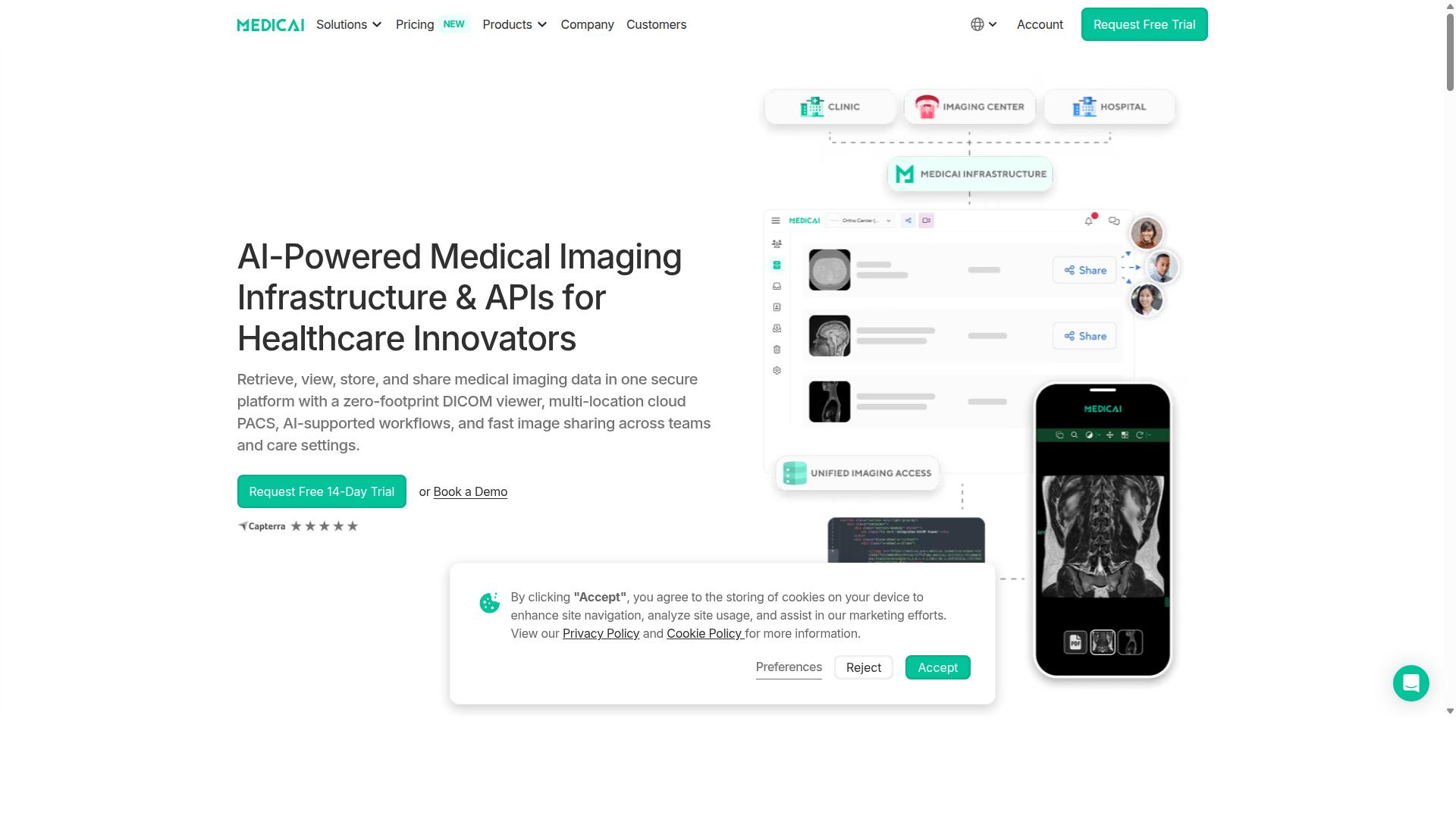
Medicai is a cloud-based medical imaging platform that provides a zero-footprint DICOM viewer for secure retrieval, viewing, storage, and exchange of imaging studies.
The platform delivers Imaging Infrastructure as a Service (IIaaS) with a multi-location cloud PACS that enables seamless interoperability across healthcare environments. It supports AI-assisted workflows and fast image sharing between teams and care settings.
Healthcare providers benefit from this unified approach when building a Vendor-Neutral Archive. The system replaces fragmented on-premise storage with scalable cloud infrastructure that grows with imaging volume demands.
Integration capabilities allow existing PACS systems to connect through standard DICOM protocols. This creates a hybrid deployment model where facilities maintain current workflows while gaining cloud advantages for long-term archive storage.
What Is AWS HealthImaging?
AWS HealthImaging is Amazon Web Services' managed medical imaging service that stores, indexes, and retrieves DICOM studies with HL7 FHIR metadata integration. It provides a cloud-native architecture designed for medical imaging workloads.
The service uses metadata indexing to support efficient image retrieval across large archives. This approach works well for organizations that need scalable storage solutions for DICOM data.
Healthcare providers often consider AWS HealthImaging when evaluating Vendor-Neutral Archive options. The service offers a pay-as-you-go cost model that aligns with cloud storage strategies.
Integration capabilities include REST APIs and SDK support for developers. Organizations can combine it with existing PACS workflows or use it as part of a hybrid deployment strategy.
What Is Medicai for Vendor-Neutral Archives?
Medicai's Vendor Neutral Archive stores 1.7M+ imaging studies and provides multi-vendor image exchange across hospitals, imaging centers, and specialty practices worldwide.
The VNA functionality sits on top of the core platform that already includes Cloud PACS and Medical Image Exchange. This layered approach means existing users gain long-term archive capabilities without switching systems or retraining staff.
The archive supports multiple specialties through the same infrastructure. Radiology, oncology, and surgical teams access the same repository through Doctor Imaging Portal and Patient Imaging Portal interfaces.
Storage occurs through CONNECT & RETRIEVE tools such as Medical Imaging Uploader and DICOM Gateway. These components feed studies into the archive while maintaining standard DICOM format.
The 300k+ visualizations generated in the last year show active clinical use. Teams retrieve studies for review, comparison, and collaboration across departments.
Backup and Disaster Recovery features protect the archive against data loss. These capabilities operate automatically and connect with existing hospital IT policies.
Compared with AWS HealthImaging, Medicai offers a unified environment where archive, viewer, and exchange functions reside together. Organizations avoid separate vendor contracts and multiple integration projects.
Features Compared
Three core feature areas, storage, integration, and security, differentiate the two platforms.
Organizations evaluating Vendor-Neutral Archive solutions need to understand how each platform handles medical imaging data at scale. These differences become critical when teams manage growing volumes of DICOM studies across multiple sites.
The comparison focuses on practical capabilities that directly impact daily operations. Storage infrastructure, workflow connectivity, and security controls provide the foundation for reliable medical imaging management.
Storage Scale and Compliance
Medicai stores 1.7M+ studies with HIPAA and GDPR compliance, while AWS HealthImaging provides HIPAA-eligible storage with automatic encryption.
Medical imaging archives require infrastructure that can accommodate expanding datasets without compromising regulatory requirements. Both platforms address these needs through different approaches to data management.
Compliance standards like HIPAA and GDPR establish baseline protections for patient information. Organizations must verify that their chosen platform maintains these standards across all stored medical imaging data.
Storage scale becomes particularly important for hospitals and clinics processing high volumes of studies. The ability to maintain compliance while handling millions of studies affects both operational efficiency and regulatory standing.
Integration and Workflow Support
Medicai's API layer processes 50M+ transactions yearly and integrates with MD.ai, Rayscape.ai, and Microsoft Azure, whereas AWS HealthImaging supports HL7 FHIR metadata indexing and AWS Lambda triggers.
Modern medical imaging workflows depend on seamless connections between different healthcare applications. Integration capabilities determine how easily teams can incorporate new tools and maintain existing connections.
API transactions enable automated data exchange between systems without manual intervention. High transaction volumes indicate robust infrastructure that supports complex multi-system environments.
Healthcare organizations often work with multiple AI tools and cloud services. The ability to connect with established platforms like Microsoft Azure provides flexibility for teams managing diverse technology stacks.
Security and Global Availability
Medicai is available worldwide with HIPAA and GDPR compliance, while AWS HealthImaging operates in AWS global regions with optional SSO and RBAC controls.
Global availability ensures medical imaging data remains accessible regardless of geographic location. This capability supports international collaboration and multi-site healthcare operations.
Access control mechanisms like SSO and RBAC help organizations maintain security standards while enabling appropriate user access. These controls become essential when managing sensitive patient information across different user groups.
Regional infrastructure affects data sovereignty considerations for healthcare organizations. Both platforms provide options for meeting local regulatory requirements while maintaining operational flexibility.
Pricing Compared
Medicai uses a flat monthly subscription; AWS HealthImaging uses a pay-as-you-go model.
Medicai offers two straightforward plans for medical imaging needs. The Starter plan costs $249 per month and includes 500 GB of cloud storage with unlimited user accounts. The Standard plan costs $749 per month and provides 2 TB of cloud storage plus one connected location.
AWS HealthImaging charges based on actual usage each month. Users pay for storage, data retrieval, and processing operations separately. This model works well for organizations with variable imaging volumes.
Organizations seeking predictable costs may prefer Medicai's subscription approach. A Vendor-Neutral Archive requires consistent budgeting for storage and access needs. Flat-rate pricing eliminates surprise charges when image retrieval increases.
Enterprise customers who need multiple connected locations can access custom pricing from Medicai. AWS HealthImaging continues to scale costs with each additional operation and storage request.
Who Should Choose Medicai
Healthcare providers that need a ready-to-deploy, subscription-priced VNA with global reach should consider Medicai.
Hospitals managing high imaging volumes benefit from the platform's ability to handle 1M+ annual studies without infrastructure changes. The system supports existing workflows and eliminates the need for lengthy procurement cycles typical in traditional Vendor-Neutral Archive deployments.
Imaging centers and specialty practices in orthopedics, neurology, oncology, radiology, cardiology, ophthalmology, ob-gyn, pulmonology, dentistry, and gastroenterology gain immediate access to compliant storage and sharing capabilities. These organizations avoid the complexity of managing cloud storage alongside their existing PACS systems.
Virtual care providers and telemedicine platforms find value in Medicai's multi-tenant architecture. The platform enables secure image exchange across different organizations while maintaining RBAC controls and SSO integration for clinical teams.
Teleradiology services and tumor boards require reliable, accessible archives that work across geographic locations. Medicai's global infrastructure supports these distributed workflows with consistent performance and compliance standards.
Personal injury lawyers, clinical trials, and medical education organizations also use the platform for secure medical imaging access. The Patient Portal extends similar capabilities to patients who need controlled access to their own studies.
Providers prioritizing compliance certifications and predictable costs find Medicai's subscription model aligns with operational planning. The approach contrasts with usage-based pricing that can create budget variability in AWS HealthImaging deployments.
Who Should Choose AWS HealthImaging
Organizations already invested in AWS infrastructure or requiring highly variable imaging workloads may prefer AWS HealthImaging. These entities often maintain large cloud estates where data residency policies align with AWS regional availability. Their teams manage imaging archives that experience unpredictable spikes in both storage volume and retrieval demand.
Healthcare systems with existing cloud storage agreements benefit from storing DICOM studies alongside other workloads. Research institutions running AI/ML pipelines on AWS find it convenient to keep imaging data within the same account boundary. This reduces network transfer costs between compute clusters and the archive.
Facilities that operate hybrid deployment models can place frequently accessed studies on premises while moving older studies to cloud storage tiers. Disaster recovery policies sometimes require duplicated copies across geographic regions, which AWS HealthImaging supports through cross-region replication.
Teams that need pay-as-you-go pricing for unpredictable study volumes may value the absence of long-term subscription contracts. Compliance officers looking for native HIPAA and GDPR controls can configure encryption and audit logging through AWS Identity and Access Management policies.
Who Should Choose Medicai for Vendor-Neutral Archives
Hospitals and imaging networks needing a vendor-neutral, multi-specialty archive with 1.7M+ studies already stored should select Medicai's VNA offering. This platform delivers a complete Vendor Neutral Archive solution that handles DICOM data across radiology, cardiology, and other specialties. The system supports both cloud and hybrid deployment models without requiring organizations to maintain separate on-premise infrastructure.
Medicai processes 1M+ annual studies and has recorded 300k+ recent visualizations. These numbers demonstrate the platform's capacity to manage high-volume medical imaging workflows. The Vendor Neutral Archive component integrates with existing PACS systems while providing long-term storage that remains independent of any single vendor's ecosystem.
Organizations requiring structured reporting, teleradiology capabilities, and tumor board support find Medicai's approach particularly useful. The platform includes a DICOM Viewer, Medical Image Exchange, and Patient Case Management tools within the same VNA environment. This unified access reduces the need for multiple separate systems.
Research suggests that healthcare networks benefit from archives offering both storage scalability and visualization features. Medicai addresses these needs through its Cloud PACS and Medical Imaging Uploader components. The system accommodates growing study volumes without requiring infrastructure changes every few years.
Compliance-focused facilities appreciate that Medicai maintains HIPAA and GDPR standards for data handling. The Vendor Neutral Archive supports encryption, audit logging, and access controls that align with regulatory requirements. Multi-tenancy features ensure proper tenant isolation when multiple departments or organizations share the same platform.
Final Verdict
Medicai's 1M+ yearly studies, 50M+ API transactions, and subscription pricing make it the stronger fit for healthcare organizations seeking a turnkey, globally available VNA. The platform serves 70 clinics and hospitals while supporting over 10,000 active doctors who access its FDA and CEE cleared viewers.
Compliance remains a core strength with HIPAA and GDPR standards built into every workflow. Organizations benefit from OWASP security guidelines and a proven track record that includes 2M+ imaging studies uploaded into the system.
Performance metrics demonstrate clear operational value. The platform delivered 300k+ DICOM study visualizations in the past year while reducing diagnosis time by 65 percent across its user base. These results stem directly from the 1.7M+ studies currently maintained in storage.
Research suggests healthcare teams prefer solutions with Microsoft Azure backing when global collaboration matters. Medicai's partnership enables multidisciplinary tumor boards that cross international borders and supports initiatives such as cancer treatment access for Ukrainian refugee patients.
Recommended Resources: